Heavy Work Activities That Help Regulate Your Child’s Nervous System
If your child crashes into furniture, drapes themselves over everything, chews on their clothing, or falls apart after a busy or unpredictable day, their nervous system may be telling you something important.
What they are looking for is proprioceptive input, sensory information from muscles, joints, and tendons that helps the brain understand where the body is in space and how much effort is being used. When the nervous system is dysregulated, proprioception acts like an anchor, pulling the brain back into a calmer, more organised state.
We call activities that provide this kind of input heavy work, and it is one of the most powerful, accessible, and underused tools available to parents, educators, and support workers.
Heavy work is not about exhausting a child into submission. It is about giving the nervous system the specific input it needs to feel safe, grounded, and ready to engage. Done well, it can reduce meltdowns, improve attention, ease transitions, and make everything that comes after it a little more manageable.
One of the most important things to know about heavy work: it is most effective before a transition or a challenging activity, not after the dysregulation has already occurred. A regulated nervous system copes. A dysregulated nervous system survives. Build heavy work into the routine before school, before therapy sessions, before homework, before anything you know is likely to be hard.
Below is a comprehensive heavy work toolkit, organised by activity type. At the end you will find a sample five-to-seven minute circuit you can start using today. If you would like to understand more about why proprioception matters at a neurological level, our post on the Taylor & Trott Pyramid of Learning explains exactly where sensory motor development sits in the developmental hierarchy, and why addressing it creates change that flows through to learning, behaviour, and daily life.
Does your child need a more targeted regulation program? At TDT, Emily builds individualised sensory and reflex integration programs for children and adults across Adelaide. Book a free 30-minute phone consultation — available Mondays 3:30–4:30pm.
Why Heavy Work Regulates the Nervous System
Proprioception is sometimes called the “hidden sense”, unlike touch or hearing, it operates largely below conscious awareness. But it is doing constant, critical work: helping the brain map the body, calibrate movement, and regulate arousal.
When a child with sensory processing differences or retained primitive reflexes engages in heavy work, several things happen in the nervous system. The proprioceptive input floods the sensory system with organising information. This activates the parasympathetic nervous system, the “rest and digest” branch, reducing cortisol and adrenaline. The body moves from a state of high alert toward a state of calm readiness. The brain has more capacity available for attention, communication, and higher-order thinking.
This is the same mechanism that makes activities like diaphragmatic breathing and vagus nerve stimulation effective, they all share the common goal of shifting the autonomic nervous system from a state of activation toward a state of regulation. Heavy work simply achieves this through the body’s movement system rather than its breathing system.
For children who experience demand avoidance or anxiety-driven behaviour, heavy work before a transition or a challenging demand can meaningfully reduce the likelihood of a refusal or meltdown, not by eliminating the demand, but by reducing the neurological cost of engaging with it.
🔹 Upper Body Heavy Work : Great for calming and attention
Upper body heavy work is especially regulating for children with retained ATNR or poor postural stability. Activities that push through the arms and shoulders send strong proprioceptive signals through the joints and into the brainstem, where arousal regulation begins.
- Crab walks
- Bear walks
- Army crawl under cushions or under a low table
- Wheelbarrow walking — hold at hips or thighs for more joint input and control
- Chair push-ups — hands on seat, lift bottom clear of chair and hold
- Resistance band rows — attach band to a door handle and pull
- Animal walks — gorilla stomps, slow sloth crawl, frog jumps
- Tug of war
- Climbing ladders or monkey bars
- Pushing a laundry basket filled with books across the floor
- Squishes — firm downward pressure over the shoulders, down the arms, and down the legs (very regulating and directly supports proprioceptive development)

Bear Crawls

Animal Walks
💡 For children with anxiety or rigidity, keep the pace slow and the rhythm predictable. Fast or competitive activities can increase arousal rather than reduce it — the goal is input, not excitement.
🔹 Core and Midline Stability : Deep regulation and bilateral integration
Core and midline work is particularly helpful when you are also targeting cerebellar stability and bilateral integration — both of which are important foundations for reading, writing, and coordinated movement. Children who struggle to cross the midline, who have poor balance, or who avoid bilateral tasks often benefit significantly from consistent core heavy work.
- Plank holds — count together slowly, make it collaborative
- Side plank with support
- Tall kneeling while pulling a resistance band
- Sitting on a therapy ball while catching a weighted ball
- Rolling on a gym ball — both on the stomach and the back
- Log rolls across a mat
- Wrap and roll — roll up tightly in a yoga mat and roll back out
- Pillow sandwich squeezes — deep pressure applied to the whole body between cushions
- Slow controlled sit-ups while holding a soft toy or small weighted ball
🔹 Whole Body Heavy Work : Organising and calming
Whole body heavy work is ideal for children who need significant input to reach a regulated state, those who are very high energy, sensory seeking, or who have been in a dysregulated state for a prolonged period. These activities provide sustained, full-body proprioceptive input.
- Carrying groceries or weighted objects
- Pushing a weighted trolley or pram
- Helping move furniture — even small, manageable pieces
- Sandbag carries
- Jumping onto a crash mat
- Trampoline with “stop and freeze” games to add regulation practice
- Sled pulling (outdoor)
- Dragging a heavy rope across the yard
- Dragging another person on a scooter or trolley
- Pulling toward someone on a trolley using hand-over-hand technique
- Gardening — digging, wheelbarrow, raking
🔹 Isometric Work : Often very calming for dysregulated children
Isometric contractions, where the muscle works hard against resistance without the joint moving, are one of the most powerful and underused forms of proprioceptive input. They are especially useful in situations where a full heavy work circuit is not possible, such as in a classroom, waiting room, or during transitions.
- Wall sit — hold for 10–30 seconds depending on capacity
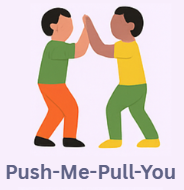
- Pushing palms together hard for 10 seconds
- “Statue freeze” in a squat position
- Press hands firmly into thighs
- Push against the therapist’s or parent’s hands
- Door frame pushes — palms flat against the frame, push outward hard
Push me Pull you
💡 Hold each isometric position for 5–10 seconds while breathing slowly. The combination of breath and resistance is particularly effective for shifting the autonomic nervous system toward calm. See our post on the importance of belly breathing for why the breath component matters.
🔹 Oral and Heavy Work Combination : For children who seek through the mouth
Some children seek proprioceptive input through the mouth, chewing clothing, mouthing objects, or needing chewy foods for regulation. This is the oral sensory system doing the same job as the body-based activities above: looking for organising input. Oral heavy work can be an important complement to body-based activities for these children.
Oral seeking is also commonly connected to retained oral reflexes and speech development, as well as to the sensory patterns discussed in our post on thumb sucking, fussy eating, and the sensory connection.
- Chewy tubes or chew jewellery
- Thick smoothies or yoghurt through a wide straw
- Blowing through resistance toys
- Blowing up balloons
- Sucking through a narrow straw — increases oral proprioceptive effort
⚠️ If the Child Is Very Dysregulated or Sensory Defensive : Start here
When a child is significantly dysregulated or defensive about sensory input, jumping straight into active heavy work can increase arousal rather than reduce it. A graded approach works better.
- Begin in prone — lying on the tummy over a therapy ball or cushion roll
- Offer slow, linear movement before any resistive heavy work
- Start with deep pressure — a firm pillow sandwich or firm shoulder squishes — before adding movement
- Avoid fast spinning, unexpected movement, or loud environments initially
- Keep your voice low, slow, and calm throughout
💡 The goal at this stage is not activity, it is safety. The nervous system needs to register that the environment is safe before it can accept organising input. Rushing this step produces the opposite result.
If your child frequently reaches states of significant dysregulation, this is a signal worth exploring further. Our post on how emotions and interoception affect behaviour explains what is happening in the nervous system during these episodes and our post on understanding demand avoidance covers the specific patterns that often accompany them.
A Ready-to-Use Heavy Work Circuit (5–7 Minutes)
Use this circuit before school, before therapy, before homework, or before any activity you know is likely to be challenging. Repeat twice for a full 5–7 minute session.
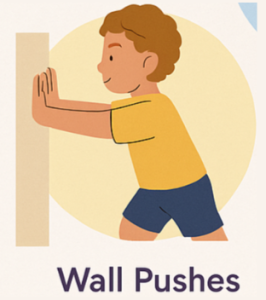
- Wall push-ups — 10 repetitions, slow and controlled
- Bear crawl across the room and back
- Trolley or basket push with weight — one length
- Log roll across a mat
- 10-second wall sit with slow breathing
- Finish with firm deep pressure squishes over shoulders, arms, and legs
Wall Pushes
This circuit can be adapted for different ages, spaces, and energy levels. The key principle is consistent delivery, the nervous system benefits most from regular, predictable heavy work rather than occasional intensive sessions.
When Heavy Work Is Part of a Bigger Picture
Heavy work is a powerful home tool, but it is most effective as part of a broader program that addresses the underlying neurological reasons why your child needs it in the first place.
If your child consistently needs significant heavy work input to reach a regulated state, or if dysregulation is affecting their learning, behaviour, relationships, or daily functioning, it is worth exploring whether retained primitive reflexes or sensory processing difficulties are contributing to the picture.
At TDT, Emily builds individualised programs that combine reflex integration, neuroplasticity-based approaches, and sensory motor work to address root causes rather than manage symptoms. As the foundational nervous system work takes effect, families often find that the amount of heavy work required to reach regulation reduces, because the nervous system is becoming better at self-regulating rather than depending on external input.
You can read more about what that process looks like in our post on positive changes as therapy progresses, and about how our support workers reinforce these strategies in everyday life in our post on what mentored support actually looks like.
Frequently Asked Questions
How often should we do heavy work?
For children who need it, daily is ideal, and short, consistent sessions are more effective than occasional long ones. Even 5–7 minutes before a known challenge point (school drop-off, homework, transitions) can make a meaningful difference. Over time, as the nervous system becomes better regulated, the frequency and intensity needed tends to reduce naturally.
Can heavy work help with attention and focus in the classroom?
Yes. Proprioceptive input has a well-established calming and organising effect on the nervous system, which directly supports attention and the capacity to engage with learning. Many teachers find that offering brief heavy work activities before a seated learning task — chair push-ups, wall pushes, carrying books, meaningfully improves engagement. For children with executive function difficulties, this kind of sensory support in the classroom can be a game-changer.
My child seeks a lot of proprioceptive input but heavy work does not seem to help. Why?
If heavy work does not seem to be producing the expected calming effect, it is worth considering whether the issue goes deeper than sensory processing. Retained primitive reflexes, poor interoception, or a nervous system that is very significantly dysregulated may mean that surface-level sensory input is not reaching the foundational neural level where the regulation problem originates. This is a conversation worth having with a therapist, our free phone consultation is a good starting point.
Can adults do heavy work too?
Absolutely. Proprioceptive input is regulating for the nervous system at any age. Many adults seek it intuitively — through exercise, weighted blankets, firm massage, or physical labour — without realising that what they are responding to is a sensory need. If an adult client has a history of sensory processing difficulties or suspected retained reflexes, heavy work can be a useful component of their broader program.
Want a program tailored specifically to your child’s nervous system?
Book your free 30-minute phone consultation with Emily at TDT.
We identify the root causes and build a program that creates lasting regulation.