

Why Your Child Struggles to Learn or Behave: A Bottom-Up Approach to Therapy
If your child melts down over what seems like nothing, struggles to sit still in class, or just cannot seem to absorb what they are being taught, you have probably heard a lot of advice about rewards, routines, and consequences. You may have tried all of it. And you may still be wondering why nothing quite sticks.
What if the real issue is not behaviour at all? What if it starts much deeper in the nervous system?
At Tailored Developmental Therapies in Mawson Lakes, Adelaide, this is exactly where we begin. Our approach is built on a simple but profound idea: before a child can learn, regulate their emotions, or manage their behaviour, the foundational layers of their nervous system need to be working well. When they are not, no amount of strategy at the surface level will create lasting change.
One of the frameworks that guides our work is the Taylor & Trott Pyramid of Learning, a model that maps the developmental layers of the brain and nervous system, and shows why building from the bottom up is the only approach that truly works.
Not sure where to start? Our free 30-minute phone consultation is designed to help you make sense of what your child is experiencing and whether TDT is the right fit. Calls are available on Mondays between 3:30–4:30pm. Book via our website.
What Is the Taylor & Trott Pyramid of Learning?
Developed in 1991 by occupational therapist Kathleen Taylor and special educator Maryann Trott, the Pyramid of Learning draws on the foundational work of Jean Ayres and the sensory integration framework. Its purpose is straightforward: to show that the brain develops in layers, and that each layer depends on the one beneath it.
Think of it like building a house. You would never start with the roof. The foundation has to be solid before anything built on top of it will hold. The same is true for a child’s development. When we see challenges with attention, learning, or behaviour, those are usually the roof, the visible problems. But the real work happens at the foundation.
The Pyramid has five levels, from the base to the apex:
- The Central Nervous System (CNS)
- Sensory Systems
- Sensory Motor Development
- Perceptual Motor Development
- Cognition, Intellect, and Functional Skills
At TDT, our therapy programs — including reflex integration, neuroplasticity, and speech and communication development — are designed to work at the lower levels of this Pyramid first, creating the conditions for genuine and lasting improvement at the top. You can also read more about our approach to assessment and how we identify the right starting point for each individual.
The Five Levels, And What They Mean for Your Child
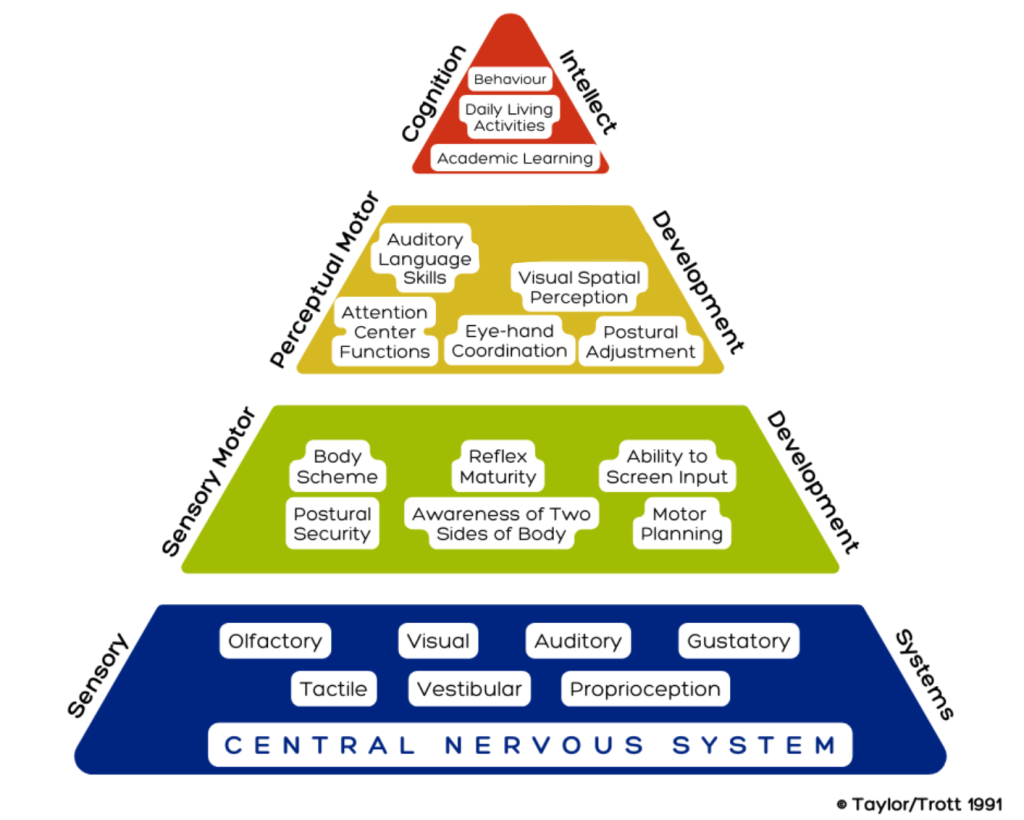
Level 1: The Central Nervous System, The Foundation
At the base of the Pyramid sits the brain and spinal cord, the entire system that receives, processes, and responds to everything your child experiences. This includes their arousal levels (are they too wired or too shut down?), their ability to regulate their autonomic nervous system, and the maturity of their neural pathways.
When this foundation is disorganised, everything built on top of it becomes unstable. One of the most important things we look for at this level is retained primitive reflexes, automatic movement patterns that should naturally integrate in early childhood but sometimes do not. When these reflexes remain active beyond their developmental window, they can interfere with higher brain functions in ways that look like inattention, emotional dysregulation, or learning difficulties.
Reflex integration therapy, one of our core services at TDT, works directly at this foundational level. Through repetitive, patterned movement sequences, we encourage the nervous system to mature and reorganise, reducing the “background noise” that interferes with everything else.
We also work with the vagus nerve, which plays a central role in regulating arousal, heart rate, breathing, digestion, emotional state, and the capacity for social engagement. When vagal tone improves, children become more settled, more present, and better able to engage with learning and connection. You can read more about how the vagus nerve affects regulation and interoception in our dedicated post.
What this can look like in your child: easily overwhelmed, frequently in ‘fight or flight’, difficulty settling to sleep, very high or very low energy, intense emotional reactions to small triggers.
Level 2: Sensory Systems, How Your Child Takes In the World
The second level of the Pyramid encompasses the body’s input channels, touch, proprioception (body awareness), vestibular (balance and movement), vision, hearing, smell, taste, and interoception (internal body signals). These systems deliver the raw data the brain needs to make sense of the world.
When primitive reflexes are retained, they can distort or bias these sensory pathways. A child might become hypersensitive to touch, sound, or movement, or conversely be under-responsive and constantly seeking more stimulation. This is not a choice or a behaviour problem. It is the nervous system doing its best with an unstable foundation.
Our therapy at this level involves carefully calibrated sensory input — deep pressure, movement, joint compression — to help the nervous system learn new thresholds and develop better regulation. Heavy work activities are one of the most effective ways to support this regulation at home between sessions. As reflex interference reduces, the sensory systems can begin to function more reliably.
What this can look like in your child: extreme sensitivity to clothing textures, loud sounds, or food textures; constant movement or crashing into things; appearing ‘in their own world’; meltdowns in busy environments like shopping centres or school.
Level 3: Sensory Motor Development, Moving With Intention
Once the sensory systems are more stable, the brain can begin to integrate sensory input with motor output, producing coordinated, intentional movement. Key skills at this level include body awareness, postural stability, bilateral coordination (using both sides of the body together), and motor planning (the ability to figure out and execute new movements).
Retained reflexes frequently interfere here, causing stiffening, asymmetry, or patterns of movement that work against the child’s intentions. This is particularly visible in activities like learning to swim, a challenge we explore in depth in our post on why some children and adults struggle to learn to swim. Reflex integration clears this interference, allowing the sensory motor system to develop more freely.
What this can look like in your child: poor balance, difficulty crossing the midline, clumsy or uncoordinated movement, avoiding sports or physical play, or legs that sink when trying to swim no matter how hard they kick.
Level 4: Perceptual Motor Development, Where Learning Meets Movement
This is the level where perception and action come together in more refined ways, the skills needed for reading, writing, catching a ball, and making sense of space. Key functions here include eye-hand coordination, visual-spatial perception, auditory processing, and sustained attention.
When the lower levels of the Pyramid are stable, a child can engage with perceptual tasks without being overwhelmed by foundational instability. Therapy at this level might include tracking exercises, visual-motor activities, and rhythmic auditory-motor tasks. With reflex interference reduced and sensory systems better regulated, these tasks become genuinely accessible rather than a source of frustration.
What this can look like in your child: difficulty with handwriting, reversing letters, poor reading fluency, trouble following multi-step instructions, difficulty concentrating in a busy classroom.
Level 5: Cognition, Learning, and Daily Living, The Visible Challenges
This is the apex of the Pyramid, and the level that most people notice first. Academic learning, behaviour, emotional regulation, executive function, social skills, and independence in daily tasks all live here. These are the things families come to us concerned about.
It is absolutely possible to work at this level using strategies, tutoring, and behaviour support. But without addressing what is happening in the lower tiers, progress is often slow, inconsistent, or does not generalise beyond the therapy room. Our approach ensures the platform is solid before expecting reliable results at the top.
As the lower levels stabilise, something remarkable happens: the brain has more capacity available for higher-order thinking. There is less interference, less compensatory effort, and more genuine readiness to learn. Families frequently tell us that changes feel sudden, but in reality, the foundation has been quietly building all along. You can read more about what families experience as this happens in our post on positive changes during therapy.
What this can look like in your child: difficulty with reading, writing, or maths; poor emotional regulation; struggles with social situations; low confidence; difficulty
with self-care tasks. If your child is being labelled as ‘lazy’ or ‘defiant’, read our post on why that label is almost never the full picture.
How Our Therapy Programs Work With the Pyramid
At Tailored Developmental Therapies, Emily (our director and lead therapist) works at the foundational levels of the Pyramid through reflex integration, neuroplasticity programs, and mentoring. Fiona (our speech therapist) works at the perceptual and functional levels through speech therapy, and in joint sessions with Emily, addresses the sensory-motor foundations that underpin communication development.
Our programs are not one-size-fits-all. We assess each client individu
ally, identify where the roadblocks are in their developmental hierarchy, and build a tailored program that works upward from there. Sessions are available at our Mawson Lakes clinic, via Zoom, or in your home, because we know that getting to a clinic is not always easy for families navigating complex needs.
We also support NDIS participants and work closely with families, schools, and other professionals to ensure that progress in therapy translates into real life. Our mentored support worker program ensures that the strategies we build in therapy are reinforced consistently in your child’s everyday environment.
Frequently Asked Questions
Is reflex integration therapy right for my child?
Reflex integration can be beneficial for children (and adults) who present with learning difficulties, demand avoidance, sensory sensitivities, coordination challenges, or behavioural concerns that have not fully responded to other interventions. The best way to find out if it is right for your family is to book a free phone consultation, we will ask the right questions and be honest with you about whether our approach is a good fit.
How long does it take to see results?
Results vary depending on the individual, the degree of retained reflexes, and other factors. Many families notice changes within the first few weeks, often in unexpected areas like sleep, emotional regulation, or ease of transitions. Our programs typically run over several months to allow genuine neural reorganisation to occur. We track progress throughout and adjust the program as your child grows.
Can this be funded through NDIS?
Yes. TDT works with NDIS participants. If you are plan-managed or self-managed, our services may be accessible to you under relevant NDIS support categories. We are happy to discuss this during your complimentary call and guide you through what funding may apply.
Do you offer online sessions?
Yes. Emily and Fiona both offer Zoom sessions, making our programs accessible to families across Adelaide and beyond. We also travel to clients where appropriate.
My child has also been struggling with communication. Is that connected?
Very often, yes. The same foundational nervous system issues that affect learning and behaviour can also affect speech and communication development. Our joint sessions between Emily and Fiona are specifically designed to address both layers at the same time.
Ready to take the first step?
Book your free 30-minute phone consultation with the TDT team.


