

Speech and Communication Development and the Role of Primitive Reflex Integration
When a child is not talking as expected, or when their speech is unclear, inconsistent, or seems to stall despite therapy, the first place most people look is the mouth. Lips. Tongue. Teeth. The mechanics of speech production.
That makes sense. But it is often not where the answer lies.
Speech and communication do not develop in isolation within the mouth. They are the product of a whole nervous system that is organised, calm, and coordinated enough to support the extraordinary complexity of human language. And when something is interfering with that organisation at a foundational level, working on speech sounds alone will only take a child so far.
At Tailored Developmental Therapies, Fiona (our speech therapist) and Emily (our director and reflex integration specialist) work together on exactly this, the intersection between nervous system foundations and communication development. It is an approach that is less common in general speech pathology practice, and one that consistently produces results for families who have found that standard speech therapy has not been enough.
This post explains what that intersection looks like, why it matters, and what it means for your child’s communication journey.
Is your child’s speech or communication development a concern? Fiona and Emily offer joint sessions that address both the communication skills and the nervous system foundations that support them. Book your free 30-minute phone consultation — available Mondays 3:30–4:30pm.
Speech Is a Whole-Body Skill
Think about everything that has to happen for a child to say a single word clearly and intentionally.
Their posture has to be stable enough to support breath control. Their breathing has to be regulated enough to power vocalisation without effort. Their nervous system has to be calm enough to access the higher brain functions where language is processed and retrieved. Their mouth, tongue, and jaw have to be coordinated enough to produce the precise, rapid movements that speech requires. And the sensory systems that give them feedback about where their tongue is and how much effort they are using have to be reliable enough that those adjustments can happen automatically.
That is an enormous amount of foundational organisation, most of it happening below conscious awareness, before a single sound is produced.
When any part of that foundation is unstable, speech is affected. Not because there is anything wrong with the child’s intelligence or their desire to communicate, but because the platform speech depends on is not yet solid enough to support it consistently.
This is why at TDT we think about speech development the same way we think about all developmental skills, using the Taylor & Trott Pyramid of Learning as our guiding framework. Speech sits near the top of the Pyramid. The nervous system, sensory systems, and sensory motor foundations sit at the base. And when the base is not solid, the skills at the top are limited by it, regardless of how much targeted therapy they receive.
What Are Primitive Reflexes and Why Do They Matter for Speech?
Primitive reflexes are automatic movement patterns present from birth that serve essential functions in early survival, feeding, bonding, protection, and early motor development. As the brain matures through infancy and toddlerhood, these reflexes are designed to integrate: to be absorbed by higher brain centres so that voluntary, purposeful movement can take over.
When this integration does not happen as expected, when reflexes remain active beyond their developmental window, the nervous system continues to rely on these primitive patterns even as it tries to develop more sophisticated skills. The retained reflexes create what we sometimes describe as “background noise” in the system: automatic demands on neural resources that should be available for higher functions like language, learning, and emotional regulation.
For speech and communication specifically, several retained reflexes are particularly significant. Their effects are often subtle at first, and are frequently missed in standard speech assessments because they do not show up in the mouth. They show up in the hands, the posture, the breathing, and the nervous system’s overall state of organisation.
The Palmar Grasp Reflex and the Hand Mouth Connection
The palmar grasp reflex causes a baby’s fingers to automatically curl closed when the palm is touched. It is one of the most recognisable newborn reflexes and serves an important early bonding and survival function.
Its connection to speech may seem surprising, but it is one of the most clinically important links in this whole picture. In the developing brain, the neural areas that control hand movements and mouth movements are closely connected, not separate systems, but overlapping and interdependent ones. This is why in early development we see babies bringing hands to mouth, mouthing objects they hold, and coordinating hand and mouth actions together. The hand–mouth connection is not a coincidence of anatomy, it is a feature of how the brain organises early motor development.
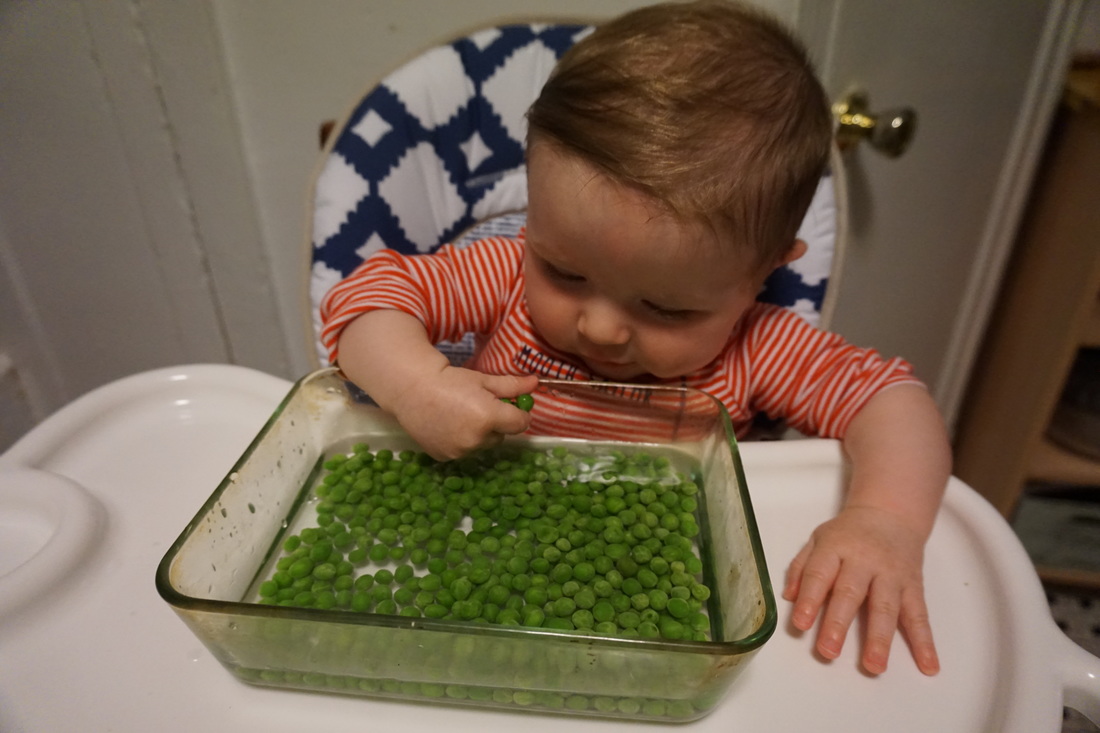
Child holding pea
As the palmar reflex integrates, this hand–mouth coordination matures. Children develop independent finger movements, refined fine motor control, and better motor planning and sequencing, and the mouth simultaneously develops the precision and coordination that clear speech requires.
When the palmar reflex is retained beyond its developmental window, the effects can include:
- Effortful or clumsy fine motor skills, difficulty with buttons, pencils, scissors
- Difficulty coordinating hand movements smoothly and independently
- Involuntary mouth movement or jaw tension when using the hands, tongue moving when writing, drooling when concentrating
- Increased whole-body tension during fine motor tasks that spills over into oral tension
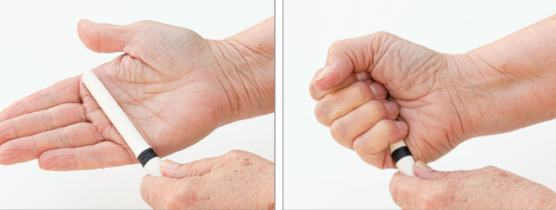
Palmar reflex demonstration using hands and pen
Because speech requires rapid, precise, coordinated motor control of the mouth, tongue, and jaw, the same system the retained palmar reflex is interfering with a retained palmar reflex can indirectly but meaningfully affect:
- Speech clarity and articulation precision
- Sound sequencing, putting sounds in the right order, consistently
- Stamina for longer or more complex speech tasks
- The fluency of connected speech, particularly under cognitive load
You might notice this in your child: their tongue moves when they are drawing or writing, they drool or hold tension in their jaw during fine motor activities, their speech is clearest when they are relaxed and most effortful when they are concentrating on something else at the same time.
The Sucking and Rooting Reflexes: From Feeding to Speaking
The sucking and rooting reflexes are the first oral reflexes to appear and among the most important. They ensure a newborn can locate and latch onto a nipple, suck effectively, and coordinate the swallow–breathe rhythm that feeding requires. Without them, a baby cannot survive independently.
These reflexes establish the earliest foundation of oral motor development. They develop the muscles of the lips, tongue, and jaw. They establish the coordination between oral movement and breathing. They begin to teach the nervous system what regulated, rhythmic oral movement feels like.
As these reflexes integrate, children move from reflexive sucking to the voluntary, graded, sophisticated oral movements needed for chewing, swallowing varied textures, and — critically — speech. The transition is gradual and depends on the nervous system maturing in an organised way.
When sucking or rooting reflexes are retained beyond their expected window, children may show:
- Immature or poorly coordinated chewing and swallowing patterns
- Excessive drooling beyond the typical developmental period
- Tongue thrusting or jaw instability, the tongue pushes forward rather than moving with precision
- Reliance on repetitive or simplified mouth movements rather than varied, precise ones
- Persistent thumb or dummy seeking as the nervous system looks for the regulatory oral input the reflex is still driving, read more about this in our post on thumb sucking, dummy use, and the sensory connection
In speech, retained oral reflexes can look like:
- Limited sound variety, a narrow repertoire of sounds the child can produce reliably
- Difficulty producing clear consonants, particularly those requiring precise tongue placement
- Speech that sounds effortful, as though the child is working hard for each sound
- Inconsistent production, a sound present one day and absent the next, with no apparent pattern
- Reduced intelligibility as language complexity increases and the motor demands of speech become greater
You might recognise this in your child: they were slow to progress through feeding milestones, still drool more than expected for their age, have unclear speech that gets worse when they are tired or talking in longer sentences, or have speech that sounds different from how it looks when you watch their mouth moving.
Why Speech Is About Far More Than Sounds
Speech is the most visible part of communication, the part we can hear and measure. But it rests on a much larger and less visible structure. Effective communication also depends on:
Postural Stability
The body needs to be stable enough to support breath control and vocalisation without effort. Children with poor postural stability, often connected to sensory motor difficulties at the third level of the Pyramid, frequently show reduced respiratory support for speech, affecting volume, prosody, and stamina.
Breath Control and Regulation
Speech is powered by breath. The coordination between breathing and speaking is a sophisticated motor skill that develops gradually, and one that is directly affected by retained reflexes and autonomic nervous system regulation. Children who are anxious, dysregulated, or habitually mouth-breathing often show reduced breath support for speech, affecting sentence length, fluency, and clarity. Read more in our post on why belly breathing matters for regulation and development.
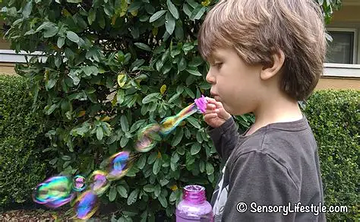
Kid blowing bubbles
Sensory Regulation
The sensory systems that give the brain feedback about what the mouth is doing, proprioception, tactile input, and interoception, need to be reliable for speech motor planning to work efficiently. When sensory processing is disorganised, the brain cannot accurately monitor and adjust oral movements in real time, resulting in inconsistent, effortful, or unclear speech.
Motor Planning (Praxis)
Producing speech is one of the most complex motor planning tasks the human brain performs. It requires sequencing dozens of precise, rapid oral movements in the right order, at the right speed, with the right coordination. Retained primitive reflexes interfere with this planning at the neurological level, not because the child does not know what they want to say, but because the motor system cannot reliably execute the plan.
Emotional Safety and Regulation
A nervous system in a state of threat or high activation does not have full access to the higher brain functions where language is processed and social engagement occurs. Children who are anxious, in demand avoidant states, or dysregulated will consistently show reduced communication, not because their language has disappeared, but because the nervous system has prioritised survival over social connection. This is not a behaviour problem. It is a neurological one.
This is why Fiona’s speech therapy at TDT uses DIR Floortime and play-based approaches, because communication develops best within relationships that feel safe, enjoyable, and child-led. You can read more about the foundations of this approach in our post on why children need foundation skills before words.
Why Reflex Integration Matters for Speech, and What Changes When It Happens
Primitive reflexes are a completely normal and healthy part of early development. Their presence in infancy is not a problem, their persistence beyond the developmental window is. And when they do persist, they quietly interfere with exactly the foundations that speech and communication depend on.
Supporting reflex integration — through Emily’s targeted reflex integration and neuroplasticity programs — can produce changes in speech and communication that pure speech therapy work cannot achieve, because it addresses the interference at its source rather than working around it.
Families and clinicians who have seen this process consistently report similar observations. As retained reflexes begin to integrate:
- The unnecessary neurological effort that was being consumed by reflex activity becomes available for communication
- Oral motor coordination improves, movements become more precise, consistent, and less effortful
- Speech clarity often improves, sometimes in sounds or patterns that have been resistant to direct therapy
- The child’s overall regulation improves, and with it their social engagement and willingness to communicate
- Higher-level language and social communication skills have more capacity to develop, because the foundational load has reduced
This is not a replacement for speech therapy, it is what makes speech therapy more effective. When the nervous system foundations are more organised, the specific skills Fiona works on in speech sessions can be learned more easily, generalised more broadly, and retained more reliably.
At TDT, Emily and Fiona regularly offer joint sessions for clients where nervous system foundations and communication development are both in focus. This is one of TDT’s most distinctive clinical offerings, and one that families who have previously found standard speech therapy insufficient often find makes a significant difference. Book a phone consultation to discuss whether this approach is right for your child.
What This Might Look Like for Your Child
The connection between retained reflexes and speech is not always immediately obvious, partly because the effects are often indirect, and partly because retained reflexes affect different children in different ways depending on which reflexes are retained and to what degree.
Some patterns that may suggest retained reflexes are contributing to speech and communication difficulties include:
- Speech that is unclear or inconsistent despite regular speech therapy
- A child who seems to know what they want to say but cannot get it out reliably
- Speech that deteriorates when the child is tired, anxious, or doing something else at the same time
- Mouth or tongue movement when using the hands for fine motor tasks
- Persistent drooling or tongue thrust beyond the typical developmental period
- Difficulty with chewing or swallowing varied textures alongside unclear speech
- A child who is very reluctant to communicate in demanding or unfamiliar environments but communicates well in safe, familiar ones
- Speech difficulties appearing alongside poor coordination, sensory sensitivities, or learning difficulties, suggesting a common neurological root
💡 If several of the above patterns resonate for your child, it is worth discussing whether a reflex integration assessment alongside a speech therapy assessment would give you a more complete picture. Our free phone consultation is the right starting point.
How TDT’s Combined Approach Works in Practice
Fiona brings to her speech therapy practice not only her qualifications as a speech-language pathologist but a deep understanding of how sensory processing and nervous system organisation affect communication. Her sessions use DIR Floortime and play-based approaches, meaning therapy follows the child’s lead, builds on their genuine interests, and prioritises the relational safety that communication development requires.
Emily brings her expertise in reflex integration, neuroplasticity-based programs, and the whole-body bottom-up approach that is TDT’s clinical foundation. Her reflex integration work directly addresses the foundational nervous system interference that limits how far speech therapy alone can progress.
In joint sessions — which are a regular part of TDT’s offering for clients where both areas are relevant, Fiona and Emily work together in real time, integrating speech goals with nervous system regulation and reflex integration work. This is not two separate therapies happening alongside each other. It is a genuinely integrated approach where each informs and supports the other.
Sessions are available at our Mawson Lakes clinic, via Zoom, or in the client’s home or school, because we know that for many families with complex needs, getting to a clinic is not always straightforward. Our mentored support workers can also reinforce communication strategies and sensory regulation approaches in the home environment between sessions.
We also support NDIS participants across plan-managed and self-managed plans, and work collaboratively with schools, other therapists, and support coordinators to ensure that progress in therapy translates into the environments where it matters most.
Frequently Asked Questions
My child has had speech therapy for years without enough progress. Could retained reflexes be the missing piece?
It is worth exploring. Retained primitive reflexes are not routinely assessed in standard speech pathology practice, which means their contribution to persistent speech difficulties often goes unidentified. If your child’s speech has plateaued or responds inconsistently to therapy, adding a reflex integration assessment to the picture may reveal interference that has been limiting progress at a foundational level. Our phone consultation is the right place to discuss your child’s specific history and presentation.
What age can reflex integration assessment and therapy begin?
Reflex integration work can begin from quite early in childhood, there is no minimum age. We also work with older children, teenagers, and adults whose reflexes were not integrated in early childhood and whose communication, learning, or daily functioning continues to be affected as a result. The specific program is always tailored to the individual’s age, presentation, and goals.
Does my child need a speech therapy diagnosis before coming to TDT?
No. A formal diagnosis is not required. Families can come to us with concerns about communication development at any stage, from early speech delays in toddlers to persistent articulation difficulties in school-aged children to communication challenges in adults. Our assessment process looks at what is actually happening in the nervous system and the communication system, not at diagnostic categories.
How does DIR Floortime fit into speech therapy at TDT?
DIR Floortime is a developmental, relationship-based approach to therapy that prioritises the child’s emotional and relational development as the foundation for all other learning, including communication. Rather than drilling isolated speech sounds, Floortime therapy follows the child’s lead and builds communication in the context of genuine connection and play. This approach aligns closely with what we know about how language actually develops — through shared emotional experiences, curiosity, and relationship — which you can read more about in our post on why children need foundation skills before words.
Can speech therapy and reflex integration be funded through NDIS?
Yes. TDT works with NDIS participants, and both our speech therapy and reflex integration programs may be accessible under relevant NDIS support categories for plan-managed and self-managed participants. We are happy to discuss funding options during your complimentary phone consultation.
My child’s speech difficulty seems connected to anxiety and avoidance. Is that relevant here?
Very much so. Communication is one of the first things to reduce when the nervous system is in a threat state, and children with demand avoidance profiles or significant anxiety often show communication difficulties that are at least partly neurological in origin rather than purely speech-motor. The safety-first approach of Fiona’s Floortime sessions is specifically designed for children whose communication is affected by anxiety and regulation, as much as by speech motor difficulties.
Is speech development a concern for your child?
Fiona and Emily work together to address both the communication skills and the nervous system foundations.
Book your free 30-minute phone consultation, the right starting point for every family.


