Understanding Demand Avoidance: Supporting Children and Adults Through Safety, Anxiety, and Nervous System Regulation
There are few experiences more exhausting, or more isolating than parenting or supporting a child who avoids demands in ways that look, from the outside, like defiance.
The child who refuses to get dressed no matter what you try. Who shuts down at the mention of homework. Who can play happily for an hour and then fall completely apart when you ask them to come to the table for dinner. Who seems to dig their heels in hardest precisely when the stakes feel highest.
If this is your child, you have probably been given advice about being more consistent, firmer, or less accommodating. You may have been told they are manipulative, attention-seeking, or simply need stronger boundaries.
At Tailored Developmental Therapies, we see something very different, and once you see it too, it changes everything about how you respond.
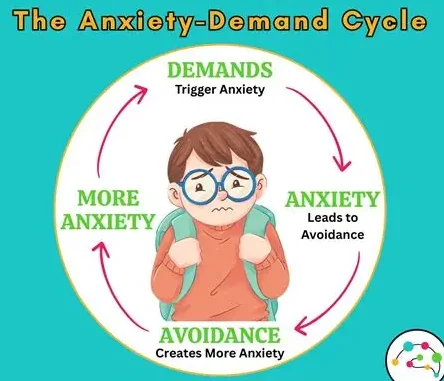
Demand avoidance is almost always driven by anxiety. Not behaviour. Not choice. Not manipulation. When we understand this, our whole approach shifts, from trying to get compliance to helping the nervous system feel safe enough to engage.
Are you supporting a child or adult with demand avoidance in Adelaide? Our free 30-minute phone consultation is a good place to start. We listen carefully and help you understand what is happening neurologically, and what might actually help. Book your complimentary call — available Mondays 3:30–4:30pm.
Demand Avoidance Is Not a Choice
For many individuals, particularly those with neurodivergent profiles including autism, ADHD, anxiety disorders, or profiles associated with retained primitive reflexes, demands can trigger an intense and involuntary stress response. The demand does not need to be large or unreasonable. Even simple, everyday requests can feel overwhelming when the nervous system is already stretched.
Starting a task. Transitioning between activities. Being asked a direct question in front of others. Being told to stop something enjoyable. Each of these can feel, to the nervous system of someone with demand avoidance, like a genuine threat to their autonomy and safety, and the nervous system responds accordingly.
What we see as refusal, the nervous system experiences as survival.
When the threat response is activated, the body moves into one of three states:
- Fight: arguing, negotiating, refusing, verbal or physical aggression
- Flight: avoidance, distraction, leaving the room, becoming very busy with something else
- Freeze: shutdown, silence, becoming unresponsive, appearing to “switch off”
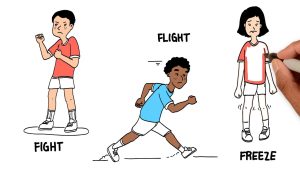
Fight, Flight or Freeze Diagram with three figures
None of these is a choice. None of them is manipulation. They are automatic, neurological responses to perceived threat, the same responses that would keep a person safe in a genuinely dangerous situation, activated by a nervous system that cannot distinguish between real danger and a request to put shoes on.
You might recognise this in your child or the person you support: they are compliant and relaxed when there are no demands, but become a completely different person the moment an expectation is placed on them. They may be able to do the thing easily in other contexts, which makes the refusal even more confusing from the outside.
The Nervous System, Anxiety, and the Role of Retained Reflexes
Understanding demand avoidance as an anxiety response is the first step. Understanding why the anxiety response is so easily activated in some individuals, and so hard to bring down, is the next.
When the nervous system is under chronic stress, it relies on lower-level survival responses rather than the higher brain functions needed for flexible thinking, social engagement, and self-regulation. For many individuals with demand avoidance profiles, this state of low-level activation is not the exception, it is the baseline.
One important and often overlooked contributor to this pattern is retained primitive reflexes. These are automatic movement and response patterns that should integrate in early childhood, freeing the higher brain to take over more complex functions. When they remain active, they can:
- Significantly increase sensitivity to pressure, expectation, and perceived loss of control
- Reduce the nervous system’s tolerance for uncertainty and unpredictability
- Make task initiation and transitions feel genuinely overwhelming
- Keep the body in a more reactive, protective state as a default
- Amplify the startle and threat response to ordinary demands
In this state, the brain is prioritising safety over learning, communication, and social participation. Strategies that focus solely on the behaviour, reward charts, consequences, firm boundaries, often fail not because the child is unwilling, but because the nervous system is genuinely not able to access the flexible thinking those strategies require.
This is also why demand avoidance so frequently appears alongside other challenges, learning difficulties, sensory sensitivities, difficulties with interoception and emotional regulation, and speech and communication. These are all expressions of the same underlying nervous system state.
Addressing retained primitive reflexes through targeted reflex integration therapy can reduce the baseline activation level of the nervous system, meaning there is less “static” in the system and more capacity available for flexible thinking and social engagement. This is not a quick fix, but families consistently tell us that as reflex integration work progresses, demand avoidance becomes less frequent and less intense. Read more about how this works in our post on the bottom-up approach to learning and behaviour.
What Actually Helps: Creating Safety First
The fundamental principle of supporting demand avoidance is this: safety before compliance. When the nervous system feels safe, engagement becomes possible. When it does not, no strategy will work consistently, because the nervous system is not in a state where learning, cooperation, or flexibility is accessible.
This does not mean removing all expectations forever. It means building the safety and nervous system capacity that makes meeting expectations genuinely possible, and then gradually, collaboratively, expanding what is possible from that foundation.
The following ten strategies are drawn from nervous system regulation and anxiety-informed practice. They are designed for teachers and parents alike, many of them work just as effectively in a classroom as in a living room.

Family smiling sitting on a couch talking with a therapist.
10 Strategies for Supporting Individuals Who Avoid Demands
- Create a Calm, Predictable Environment
The nervous system of a person with demand avoidance is constantly scanning for threat. An environment that is calm, consistent, and low in unexpected demands gives the nervous system fewer reasons to activate the threat response. This means reducing background noise where possible, maintaining predictable routines, minimising sudden changes, and ensuring the physical environment is not adding sensory load on top of social and task demands.
A calm environment is not a permissive environment, it is a strategic one. The goal is to preserve the child’s neurological capacity for the moments when demands genuinely cannot be avoided.
💡 If transitions are a consistent trigger, visual schedules and advance warning of upcoming changes are some of the most effective environmental supports available. Knowing what is coming next reduces the nervous system’s uncertainty load significantly.
- Give Clear, Simple, Non-Pressured Instructions
Demands that feel open-ended, complex, or urgent are more likely to trigger avoidance than those that are clear, simple, and low-pressure in their delivery. Break tasks into the smallest possible steps. Give one instruction at a time rather than a sequence. Use a calm, neutral tone rather than one that signals urgency or frustration, the nervous system reads tone before it processes words.
Where possible, frame instructions as information rather than demands. “We are going to the car in five minutes” lands very differently in the nervous system than “Get your shoes on now.”
- Use Genuine Positive Reinforcement
Notice and name effort specifically, not just outcomes. “I noticed you came to the table even though you were in the middle of your game. That was really hard and you did it” is far more effective than generic praise, because it shows the child that their internal experience has been seen and understood. This builds trust and reduces the anxiety that accompanies demands, because the child learns that engaging does not mean losing their experience being acknowledged.
Avoid performative or pressured praise, which can feel demanding in itself to a child with a demand avoidance profile.
- Offer Meaningful Choices
The core of demand avoidance is a nervous system response to perceived loss of control. Offering genuine choices, not false choices designed to achieve the same outcome regardless, restores a sense of agency that can meaningfully reduce the threat response.
Choices can be small: which task to start with, where to sit, which version of an activity to do. The size of the choice matters less than the genuineness of it. If both options are acceptable to you regardless of which is chosen, it is a real choice. If one option is the “right” answer, it is not.
💡 For children with significant demand avoidance, even framing a task as optional when possible can make a meaningful difference — ‘Would you like to try this?’ rather than ‘You need to do this now.’ The nervous system response to invitation is measurably different from its response to instruction.
- Set Realistic, Collaborative Goals
Starting is almost always the hardest part for someone with demand avoidance, the anticipation of the task is often more activating than the task itself. Breaking larger goals into the smallest meaningful starting steps, and negotiating those steps collaboratively rather than imposing them, can significantly lower the activation cost of beginning.
“What would be one small thing you could do?” invites participation in a way that “You need to do all of this” does not.
- Provide Scaffolding and Structure
Open-ended tasks with no clear structure are high-demand for the nervous system, they require the individual to generate their own organisation under pressure, which is cognitively costly when anxiety is already elevated. Templates, graphic organisers, visual step-by-step guides, and worked examples all reduce this load.
Scaffolding is not lowering expectations, it is removing the unnecessary friction that stands between the person and the task. A useful free tool for breaking tasks into steps is Goblin Tools, which can help both children and adults decompose overwhelming tasks into manageable steps.
- Facilitate Safe Peer Connection
Social demands can be among the most activating for individuals with demand avoidance profiles, because they involve unpredictability, the need for rapid flexible responding, and the constant implicit demand of social reciprocity. Supporting positive peer connection in low-pressure, interest-based contexts — where the child can engage at their own pace without performance anxiety — builds social capacity gently and sustainably.
Forced social interaction or social demands that exceed the child’s current capacity tend to increase avoidance rather than build the skills the interaction is intended to develop.
- Prioritise Movement and Hands-On Learning
Movement is one of the most reliable routes to nervous system regulation available in a classroom or home environment. Heavy work and proprioceptive activities, carrying, pushing, pulling, resistive movement, shift the autonomic nervous system toward calm and increase the capacity for sustained engagement.
Hands-on and experiential learning also reduces the anxiety associated with “performing” knowledge, because the focus is on doing rather than demonstrating. For many individuals with demand avoidance, the fear of getting something wrong is as activating as the demand itself.
- Use Time-Limited Tasks With Visual Countdowns
The prospect of an open-ended task — one with no clear stopping point — can be genuinely overwhelming for a nervous system that needs predictability. Short, time-limited tasks with clear endings are far more manageable than long tasks framed as ongoing obligations.
Visual timers (rather than verbal countdowns, which can feel pressured) allow the individual to see the end of the demand approaching, which reduces the activation cost of sustaining engagement. “Just until the timer” is a much smaller ask than “until you are done.”
- Maintain Consistent Communication Between Home and School
One of the most powerful things any team around a child with demand avoidance can do is maintain consistent communication and shared strategy. When the approach at home and at school is aligned, same language, same principles, same understanding of what the child needs, the child’s nervous system experiences a more coherent and predictable world, which reduces baseline activation.
This consistency is a core part of how TDT’s mentored support workers operate, ensuring that the strategies developed in therapy and case planning are carried through into the home and community environments where the child spends most of their time.
Why Patience and Flexibility Are Not Optional
Every individual with demand avoidance is different. What feels manageable for one person may be genuinely overwhelming for another, even when the tasks appear identical. This is because the experience of demand avoidance is not primarily about the task, it is about the current state of the nervous system and the perceived level of threat.
When we respond to demand avoidance with patience, genuine curiosity, and flexibility, we do something important: we send a signal to the nervous system that this environment is safe. That the adult is not a threat. That it is possible to be in this situation without the full defensive response being necessary.
Over time, and it does take time, this signal accumulates. The nervous system learns, gradually, that demands in this context do not have to mean danger. Avoidance begins to soften not because pressure increased, but because safety did.
You might notice this shift happening in small moments first, a task accepted with less resistance than usual, a transition completed without the usual fall-apart, a brief moment of engagement before the avoidance kicks in. These small moments are significant. They are evidence that the nervous system is starting to experience something different.
A Whole-Body Approach to Demand Avoidance
Supporting individuals with demand avoidance is not about permanently removing expectations. It is about building the nervous system capacity that makes meeting expectations genuinely possible, and doing that work from the ground up rather than from the top down.
This means addressing:
- Anxiety and autonomic nervous system regulation
- Retained primitive reflexes that maintain a high baseline of threat sensitivity
- Sensory processing and interoception, the ability to sense and interpret internal body states
- Emotional safety in relationships with key adults
- The specific contexts and triggers that consistently activate the threat response
When these foundations are addressed, learning, communication, and participation tend to emerge naturally, not because the person has been made to comply, but because their nervous system finally has the capacity to engage.
This whole-body perspective is central to everything we do at Tailored Developmental Therapies. Emily’s reflex integration and neuroplasticity programs work directly at the foundational level, addressing the nervous system roots of demand avoidance rather than its surface expressions. Fiona’s speech therapy sessions, conducted using DIR Floortime and play-based approaches, ensure that communication development happens in an environment of safety and genuine connection rather than performance and compliance.
You can read more about the foundational framework behind our approach in our post on the Taylor & Trott Pyramid of Learning, and about how interoception and emotional regulation connect to the patterns described in this post.
For families whose children are also experiencing demand avoidance in school settings specifically, our post on supporting children with executive function difficulties at school covers practical advocacy steps and the legal frameworks that schools are required to work within.
Frequently Asked Questions
Is demand avoidance the same as PDA (Pathological Demand Avoidance)?
PDA is a profile most commonly described within the autism spectrum, characterised by an extreme and pervasive avoidance of everyday demands driven by high anxiety and a need for control. Not all demand avoidance is PDA, demand avoidance as a nervous system response to anxiety can appear in many different neurodevelopmental profiles. The principles in this post apply broadly, regardless of whether a formal PDA profile has been identified. What matters most is understanding the anxiety driving the behaviour, not the label attached to it.
My child is assessed as having average or above-average intelligence. Why do these strategies not work?
Intelligence and nervous system regulation are entirely separate systems. A child can be highly cognitively capable and simultaneously have a nervous system that is operating in a chronic state of threat activation, in fact, many bright children are particularly adept at masking or intellectualising their anxiety in ways that make the demand avoidance more confusing to the adults around them. Read more about this pattern in our post on why children are not lazy — they think differently.
We have tried everything and nothing works. Is there something TDT can do differently?
The most common reason that behavioural strategies for demand avoidance do not produce lasting results is that they target the surface behaviour without addressing the nervous system state driving it. TDT’s programs work at the foundational neurological level, reflex integration, sensory regulation, autonomic nervous system support, which changes the baseline from which demand avoidance operates. This is not a short process, but it tends to produce changes that are genuine and lasting rather than dependent on ongoing management. Our free phone consultation is the best starting point.
Can adults experience demand avoidance too?
Yes. Demand avoidance is not limited to childhood and does not automatically resolve with age, particularly when the underlying nervous system patterns have not been addressed. Adults with demand avoidance profiles often develop sophisticated masking and avoidance strategies that make the pattern less visible but no less costly in terms of energy, relationships, and daily functioning. TDT works with adults as well as children, and our programs are adapted to suit adult presentations and goals.
How does reflex integration specifically help with demand avoidance?
Retained primitive reflexes — particularly the Moro (startle) reflex — keep the nervous system in a heightened state of threat sensitivity. When the Moro reflex is retained, the threat threshold is lower, the recovery time from activation is longer, and the nervous system’s capacity for flexibility and engagement is reduced. Reflex integration work gradually reduces this baseline reactivity, meaning the nervous system is less easily activated by ordinary demands and more able to recover when it is. Families typically begin to notice changes in the frequency and intensity of demand avoidance within the first few months of a reflex integration program. Read more about this in our post on why some children struggle in challenging environments.
Can this be funded through NDIS?
Yes. TDT works with NDIS participants, and our therapeutic programs may be accessible under relevant NDIS support categories for plan-managed and self-managed participants. We are happy to discuss how your plan can support a reflex integration or therapeutic program during your complimentary phone consultation.
Is demand avoidance affecting your child’s daily life — or yours?
Book your free 30-minute phone consultation with the TDT team.
We work with children and adults to address the nervous system roots of demand avoidance.